What is a vegetable? (Comic prototype)
Date: February 24th, 2026
Author: Kirsten Whalley
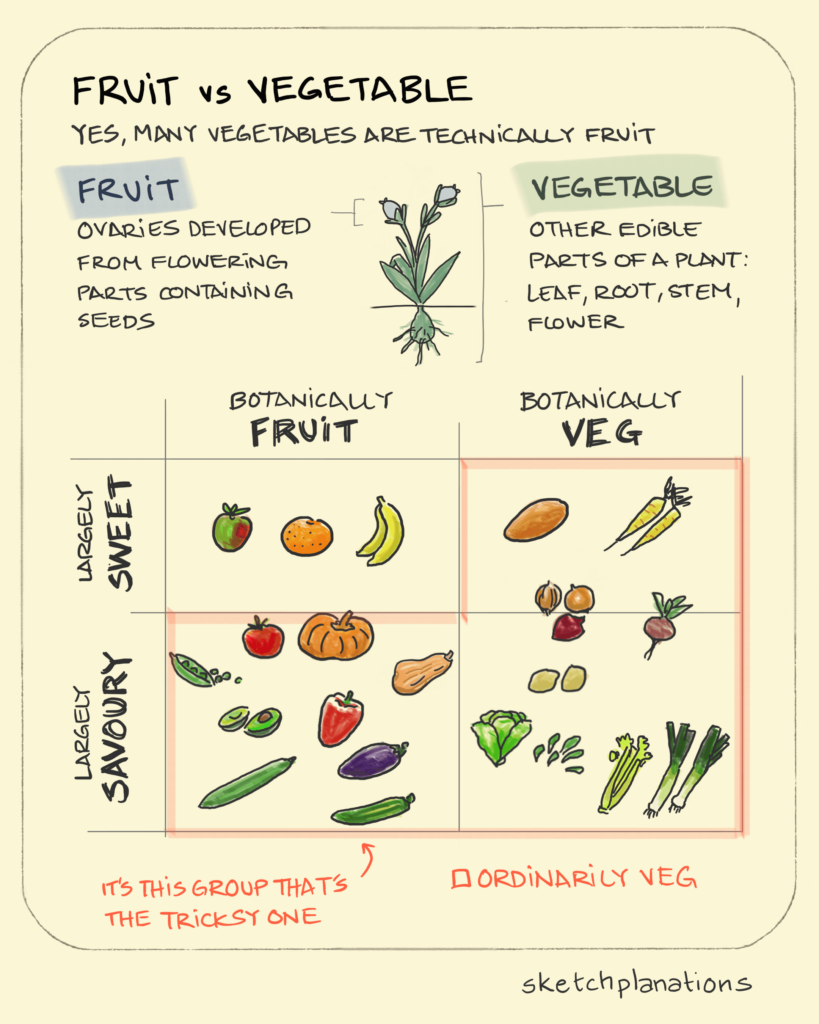
For the comic multimedia challenge, I will be creating a comic strip about the classification of vegetables and how the term is not recognized in biology but is considered common knowledge. I wish to highlight social constructs that help us understand our world, known in sociology as typification (Gunderson, 2020). I became fascinated with the concept of typification after being introduced to it in a second-year sociology class last year and have wondered why it isn’t something most people are familiar with since. I am creating this comic strip to practice turning theoretical concepts into more digestible forms of media to share with others, whether it be with friends or with students. My goal for this project is to provide a framework that can be used to evaluate other social constructs in a straightforward way. I recognize that social constructs are very complex and are deeply ingrained in our societies, which is why I will be focusing on supporting initial questioning and critical thinking, rather than on how to alter their impact and their potential harms.
The Process
Understand
THE CHALLENGE:
Children will learn that categorizations created by humans to help us understand our world do not always represent the truth. To demonstrate this, the classification of vegetables will be used, as it is a simple example that highlights this topic and leaves out complex moral and ethical considerations.
CONTEXT AND AUDIENCE:
The primary audience for this comic is high school students, as the challenge requires inquisitive and critical thinking. This requirement is aligned with the BC education curriculum for high school science, where learners are encouraged to question and make hypotheses about the natural world (B.C. Curriculum, 2026). On top of this, the learning resource will allow learners to think more about what they are eating and what it takes for food (particularly produce) to end up on their plates. This will be done through the use of storytelling to keep the audience engaged and to evoke senses of empathy and inspiration.
Children in Western culture are often told they must “eat their vegetables” before they can do something they want, like having dessert; because of this, some learners may have negative relationships with vegetables. There may also be learners that do not like eating some or many vegetables for a plethora of reasons. By framing vegetables in a different light, learners’ relationships to vegetables may shift as they learn more about them.
Children spend their lives being told information to believe, some of which they won’t be able to verify. By exposing a common label we are told to be true, learners can begin to question what they have been told. This may let learners attach new knowledge of vegetables on top of what they already know and help them build their own understandings. These categorizations we are exposed to act as ‘shortcuts’ for cooking, grocery stores, and even taxation, but they have entered our lives as ‘fact’; highlighting this will open up conversation about what else is simplified for ease or promotion of business.
POV STATEMENT:
High school students need to compare how we label “vegetables” in the kitchen versus how they are defined in science so they understand that human categories are often just useful shortcuts rather than “the truth,” helping them become more critical thinkers about the world and their food.
LEARNING OBJECTIVES:
- Understand that just because a label is common doesn’t mean it’s the only way to see the truth.
- Explain that we categorize items based on how we use them rather than what they are.
- Learn that the categories we create for the world are just helpful tools, not necessarily reality
- Use the “vegetable” example to practice questioning other “standard” facts in the natural world.
Plan
IDEATION:
Being an ecology student, I interact with plants often and examine our relationships to them. I have known about how the classification “vegetable” is a very broad and all-encompassing term, but I was curious as to why I didn’t know much about it given my area of study. After reflecting on the topic, I realized it could be used as an example of how we classify certain things to help us understand the world around us. Most examples I’ve come across of this kind of classification are often quite negative, most often in the form of othering to promote a dominant culture. I thought the example of the classification of vegetables would allow learners to explore the concept of typification that doesn’t result in impacts to individuals or groups.
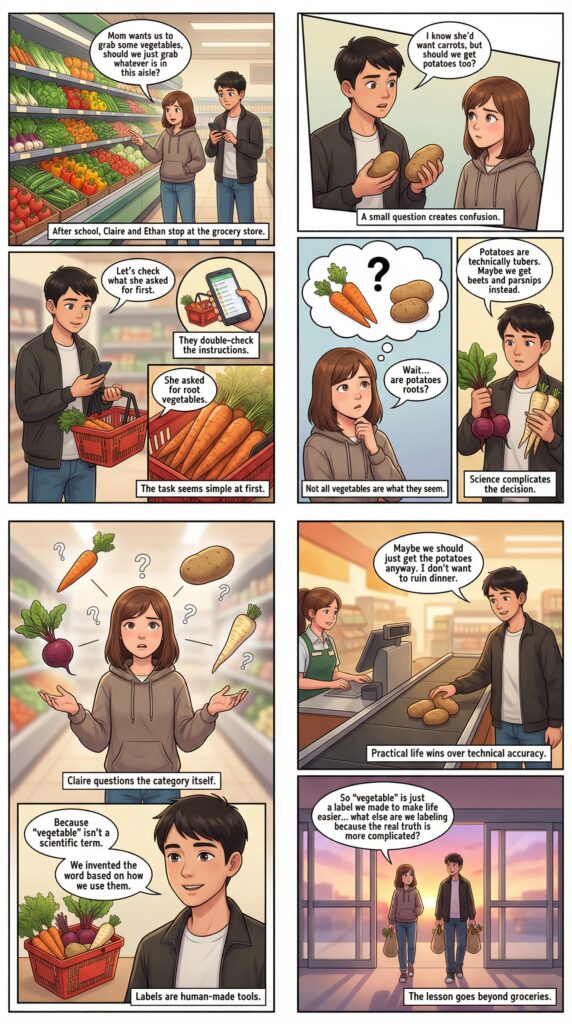
The first draft I thought of was to have a child sorting commonly known fruits and vegetables into categories and a parent explaining the difference, but upon reflection, this narrative would not be able to facilitate the learning objectives properly, and the learner would not be able to connect with either of the characters. Then I had the idea of two siblings in a grocery store in the produce section having a discussion about which vegetables they should get. This allows for a conversation to take place about the categorization of vegetables and what else it could symbolize.
STORYBOARD:
- Panel #1
- Dialogue- Claire: “Mom wants us to grab some vegetables, should we just grab whatever is in this aisle?”
- Setting- Claire and Ethan in the produce section in a grocery store.
- Panel #2
- Dialogue- Ethan: “She asked us for root vegetables. I know she’d want carrots, but should we get potatoes too?”
- Setting- Ethan holding potatoes, with carrots in their basket already
- Panel #3
- Dialogue- Claire: “What do you mean? Are potatoes roots?”
- Setting- Claire looking confused, thinking about carrots and potatoes being equal
- Panel #4
- Dialogue- Ethan: “Potatoes are technically tubers. Maybe we get some beets and parsnips instead.”
- Setting- Ethan holding beets and parships, looking relfective
- Panel #5
- Dialogue- Claire: “But aren’t they all just vegetables? Why are they all so different?”
- Setting- Claire wondering about different kinds of vegetables
- Panel #6
- Dialogue- Ethan: “Because ‘vegetable’ isn’t a scientific term. We invented the word based on what we do with them, not what they actually are.”
- Setting- Ethan with just the basket in his hands with the carrots, beets, and parsnips in the basket
- Panel #7
- Dialogue- Claire: “I guess I never thought about it. They are all quite different from each other, but we say they are all the same.”
- Setting- Claire thinking about vegetable classification and how we put them all in the same category
- Panel #8
- Dialogue- Ethan: “Categorizing the plants we eat makes it easier for us to understand what we are eating, but it’s not really the ‘absolute truth’ of the plant’s identity.”
- Setting- Ethan in a kitchen preparing vegetables
- Panel #9
- Dialogue- Ethan: “Maybe we should just get the potatoes anyways. I don’t want to explain to Mom that I didn’t get potatoes because they aren’t really roots, it might ruin dinner.”
- Setting- Ethan holding the potatoes anyways, at the cashier waiting to pay
- Panel #10
- Dialogue- Claire: “Okay, so ‘vegetable’ is just a label we made up to make life easier. It makes me wonder… what else are we just slapping labels on because the actual truth is too complicated?”
- Setting- Claire and Ethan outside of a supermarket leaving the store
THEORY APPLIED:
Universal Learning Design: The audience that can participate will be limited to those who can read and comprehend English; keeping this in mind during the creation period will prioritize learners’ needs and will aid in accessibility. The language used in the multimedia will be in plain English and will be intentionally segmented into smaller chunks of text. Using informal language (use of “I,” contractions, emotions, and relaxed diction) will allow learners to feel more connected to the story.
Dual-Coding Theory: Since the multimedia will be in PDF form, there will only be images and text displayed, which will by default encompass Paivio’s Dual-Coding Theory. To utilize the theory further in this format, close attention will be paid to where the images and text are located and the amount of each to help the two channels of processing to work at the same time.
Active Processing: Learners should be quite familiar with vegetables and what they have been told about them. This will help learners to take in new information that will then be linked to what they already know.
The Prototype
AI Usage
I acknowledge the use of ChatGPT to generate the comic strip for this assignment. I entered the following prompts on February 25th, 2026: “Can you build a 10-panel educational comic strip with a target audience of high school students? This is for an assignment for an upper-level university education course titled ‘interactive and multimedia learning.'” Then gave it the whole script with the dialogues and settings that can be viewed above.
I acknowledge that there are biases present when using generative AI. For the comic strip, the only characteristics I provided for the characters were their names and that they were siblings. Because of the AI’s popularity bias, it assumed the gender, ethnicity, and culture of each character involved, which obviously leaves out underrepresented and/or marginalized communities.
References
B.C. Curriculum. (2026). Science: Building Student Success. https://curriculum.gov.bc.ca/curriculum/science