Multimedia Critique
To apply core concepts such as ‘theories of multimedia learning,’ ‘models of active learning,’ and ‘accessibility and universal design learning,’ I wish to evaluate three different educational resources to deepen my understanding. Although the resources chosen to be critiqued were most likely not intended for post-secondary use, I will be evaluating them against post-secondary standards to assess their educational design. The evaluation will not be focused on the overall content provided but instead on the resources’ effectiveness, engagement, and accessibility.
Assessment Rubric
| Criteria | Inadequate 1 | Marginal 2 | Adequate 3 | Very Good 4 | Excellent 5 |
| Theories of Multimedia Learning (Principles of Multimedia Learning, 2016). | Results in high intrinsic and extraneous cognitive load. No attempts to promote germane cognitive load. | Less cognitive strain. Exhibits some redundancy, signalling, and segmenting, but room for germane cognitive load is still low. | 1 or 2 instances of redundancy and/or straying from main topic. Appropriate information and media present, but requires improved organization. | Very little cognitive load, intentionally making room for germane load. Done through the use of signalling, segmenting, and modality. Ideal media organization. | Content presented in a way that shows mastery of cognitive load reduction. Caters perfectly to the desired audience, while not excluding others. |
| Models of Active Learning (Merrill, 2002). | No promotion of active learning. Content is exclusively passive | A question posed at the beginning and/or end of the lesson to actively engage the learner. | Increased cognitive engagement through the use of reflections and discussions. Some previous knowledge is activated. | Learner is encouraged to actively participate in interactive lessons. | Designed so the learner can construct their own learning endeavours within the lesson. Real scenarios are used to keep learners engaged. |
| Accessibility & Universal Design for Learning (UDL) (CAST, 2024). | Content is inaccessible to learners who require audio and/or visual support and provides no room for autonomy. | Videos have auto-generated closed captioning. Images are explanatory but do not contain adequate captions or alternative texts. | Captioning and alternative texts are present but do not result in proficient learning. The resource is organized to ensure proper navigation but could be more intuitive and seamless. | Open and/or closed captioning present where appropriate. Alternative text describes images well. UDL is considered and implemented. | Content is accessible to anyone who wishes to partake and designed in a way that learners can seamlessly navigate throughout. |
Rubric Rationale

This assessment rubric was designed to critique a wide range of interactive and multimedia educational resources with respect to the learners’ experiences and outcomes. Richard Mayer’s Principles of Multimedia Learning (2016) were used to guide the first criterion, with a particular focus on cognitive load theory and how it can be integrated into educational resources. The second criterion was structured around Mayer’s (2002) First Principles of Instruction, where he outlined that in order for learners to gain deeper understandings of materials, they must take an active role in the lesson. The last criterion was based on the CAST (2024) Universal Design for Learning Guidelines, which follow a framework that prioritizes engagement, representation, and action and expression.
Educational Resources
Excellent Resource
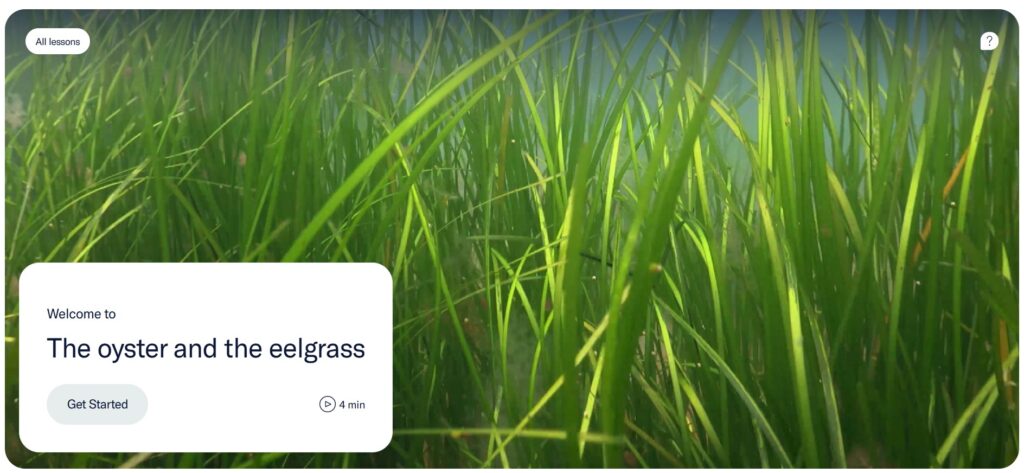
The Oyster and The Eelgrass by Ocean School.
Rubric Scoring & Justification
Theories of Multimedia Learning: 5/5
- Everything presented on each page is relevant and necessary.
- The video is narrated throughout, the only times there are words present, the narration pause, following the dual coding theory
- Images and videos shown complement what is being narrated and do not stray from this pattern.
Models of Active Learning: 5/5
- Questions asked throughout.
- To-do list of tasks presented after the video promotes learners to think about positive and negative impacts explore in the prior video.
- An image is given for students to draw out their ideas.
- Page dedicated to “what are you wondering about,” which allows learners to explore their own ideas regarding the issue at hand.
- Real-world example of ecological interactions promoting thinking of impacts of actions.
Accessibility & Universal Design Learning: 5/5
- Accurate open and closed captioning is present throughout the video.
- A complete transcript is provided on the same page as the video.
- Audio description provided.
- A QR code is embedded into the video design to allow learners to share to other devices.
- The reflection activity is provided in both PowerPoint and Google Slides formats, allowing the learner to chose one that works for them.
Okay Resource
Types of Climate by Smile and Learn.
Rubric Scoring & Justification
Theories of Multimedia Learning: 3/5
- The whole video is narrated, and there is a lot of text, which raises intrinsic load.
- The narration is quite monotone and sounds computer-generated.
- Labels remain close to their designated image or symbol
- Content is well segmented and organized into separate larger themes.
Models of Active Learning: 2/5
- Questions are integrated throughout the video.
- Begins with asking about the learners’ current weather.
- Lecture-focused rather than promoting learner participation.
Accessibility & Universal Design Learning: 3/5
- Close captioning is provided but is auto-generated.
- Very distracting and loud background music that persists throughout the whole video.
- Begins by providing general definitions before diving into more complex ideas, ensuring learners have adequate information to participate in the lesson.
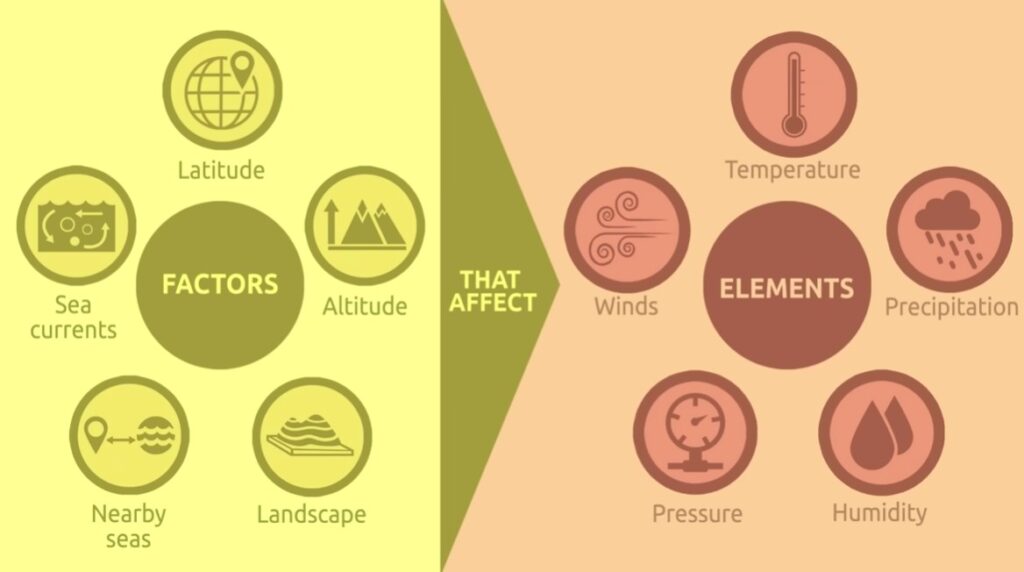
- Most of the text has very poor contrast, making it harder to see and not accessible to some (see figure 1).
Poor Resource
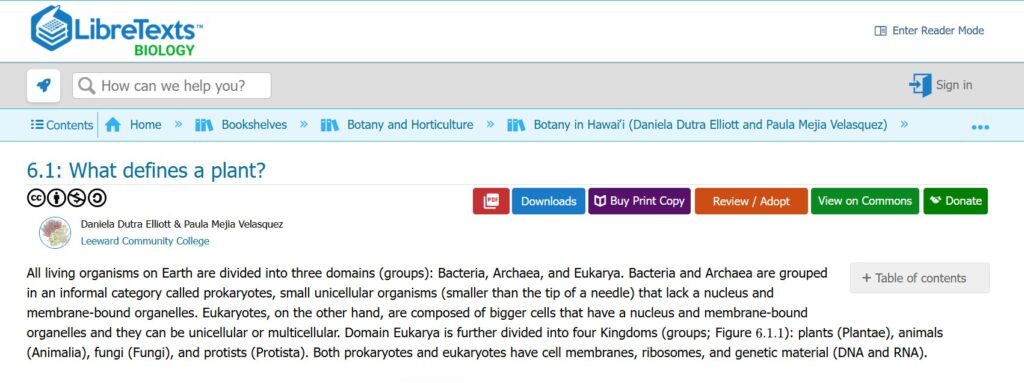
What defines a plant? by Biology LibreTexts.
Rubric Scoring & Justification
Theories of Multimedia Learning: 1/5
- Content is very poorly organized and lacks segmenting.
- The only headings used are the title and “Origin of plants” about halfway through. Subheadings are necessary for this dense content.
- Content is not coherent, it goes from basic plant knowledge to very scientific jargon.
Models of Active Learning: 1/5
- No questions are asked throughout the lesson.
- No reflection is promoted as learners work their way through the dense content.
Accessibility & Universal Design Learning: 1/5
- Not enough foundational definitions are given in the beginning to ensure learners can understand the rest of the content.
- Audio for the text is not provided, though the text is selectable, making it compatible with screen readers.
- The site this lesson is provided by is open and can be accessed by those who wish to.
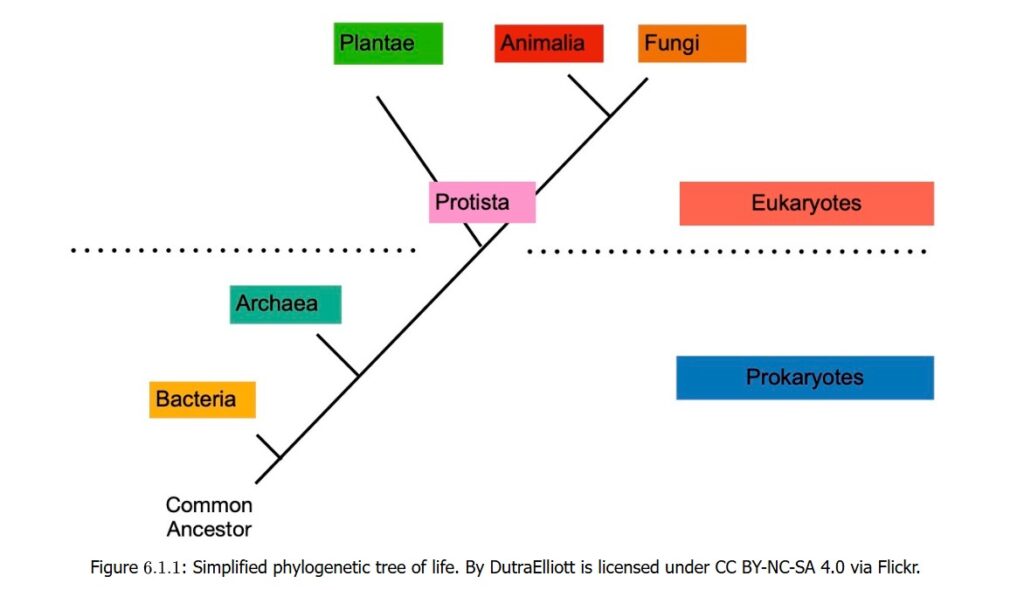
- Three images are used: two graphs and one microscope image, each of which are very poorly integrated
- The first image (see figure 2) is a very confusing graph of different types of organisms that does not have a descriptive caption or alternative text.
- The microscope image is not referenced in the text, and its caption mostly refers to the species’ scientific name and fails to describe what is happening in the image.
References
CAST. (2024). CAST Universal Design for Learning Guidelines version 3.0. https://udlguidelines.cast.org/
Libretexts. (2024, January 30). What defines a plant? Biology LibreTexts. https://bio.libretexts.org/Bookshelves/Botany/Botany_in_Hawaii_(Daniela_Dutra_Elliott_and_Paula_Mejia_Velasquez)/06%3A_Plant_evolution_and_non-vascular_plants/6.01%3A_What_defines_a_plant
Loveless, B. (2023). Dual Coding Theory: The Complete Guide for Teachers. Education Corner. https://www.educationcorner.com/dual-coding-theory/
Merrill, M. D. (2002). First Principles of Instruction. Educational Technology Research and Development, 50(3), 43–59. https://doi.org/10.1007/bf02505024
Ocean School. (n.d.). The oyster and the eelgrass. https://oceanschool.nfb.ca/student/media/the-oyster-and-the-eelgrass
Principles of Multimedia Learning. (2016). Center for Teaching and Learning. Wiley University Services. https://web.archive.org/web/20240521080909/https://ctl.wiley.com/principles-of-multimedia-learning/
Smile and Learn. (2020). Climate for kids – Types of climate [Video]. YouTube. https://www.youtube.com/watch?v=iA23Sm-HI4I