What is a Vegetable? (Comic Final)
Date: March 5th, 2026
Author: Kirsten Whalley
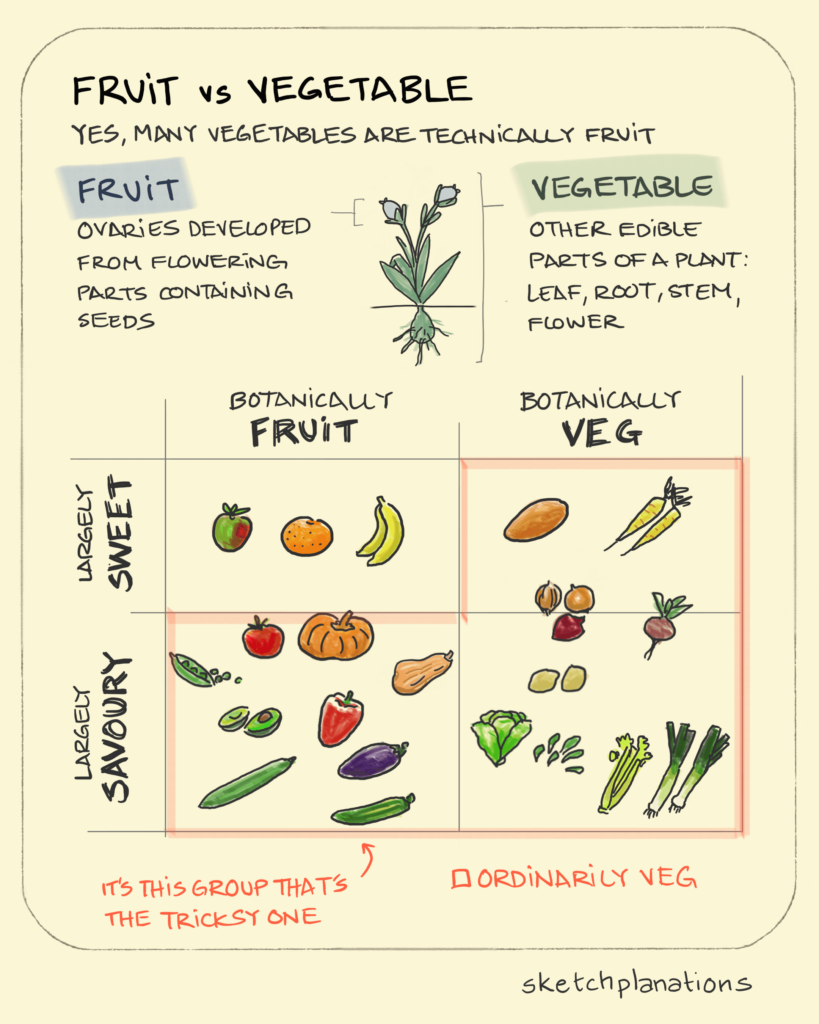
For the comic multimedia challenge, I wanted to create a narrative that follows a simple example of how we use catagories to help us understand the world around us, known in sociology as typifications (Gunderson, 2020). I decided to created a comic strip that follows a narrative about the categorization of vegetables and how it is not a biological term but is accepted as common knowledge.
This comic strip was created to practice turning theoretical concepts into more digestible forms of media to share with others, whether it be with friends or with students. The goal for this project is to provide a straightforward framework that can be used to evaluate other social constructs. I recognize that social constructs are very complex and are deeply ingrained in our societies, which is why the focus will be on supporting initial questioning and critical thinking, rather than on how to alter their impact and their potential harms.
The Process
Understand
THE CHALLENGE:
High school students will learn that categorizations created by humans to help us understand our world do not always represent the truth. To demonstrate this, the classification of vegetables will be used, as it is a simple example that highlights this topic and leaves out complex moral and ethical considerations.
CONTEXT AND AUDIENCE:
The primary audience for this comic is high school students, as the challenge requires inquisitive and critical thinking. This requirement is aligned with the BC education curriculum for high school science, where learners are encouraged to question and make hypotheses about the natural world (B.C. Curriculum, 2026). On top of this, the learning resource will allow learners to think more about what they are eating and what it takes for food (particularly produce) to end up on their plates. This will be done through the use of storytelling to keep the audience engaged and to evoke a sense of empathy and inspiration.
Kids in Western culture are often told they must “eat their vegetables” before they can do something they want, like having dessert. Because of this, some learners may have negative relationships with vegetables. There may also be learners that do not like eating some or many vegetables for a plethora of reasons. By framing vegetables in a different light, learners’ relationships to vegetables may shift as they learn more about them.
Kids spend their lives being told information to believe, some of which they won’t be able to verify. By exposing a common label we are told to be true to, learners can begin to question what they have been told. This may let learners attach new knowledge of vegetables on top of what they already know and help them build their own understanding. These categorizations we are exposed to act as ‘shortcuts’ for cooking, grocery stores, and even taxation, but they have entered our lives as ‘fact’; highlighting this will open up conversation about what else is simplified for ease or promotion of business.
POV STATEMENT:
High school students need to compare how we label “vegetables” in the kitchen versus how they are defined in science so they understand that human categories are often just useful shortcuts rather than “the truth,” helping them become more critical thinkers about the world and their food.
LEARNING OBJECTIVES:
- Understand that just because a label is common doesn’t mean it’s the only way to see the truth.
- Explain that we categorize items based on how we use them rather than what they are.
- Learn that the categories we create for the world are just helpful tools, not necessarily reality
- Use the “vegetable” example to practice questioning other “standard” facts in the natural world.
Plan
IDEATION:
Being an ecology student, I interact with plants often and examine our relationships to them. I have known about how the classification “vegetable” is a very broad and all-encompassing term, but I was curious as to why I didn’t know much about it given my area of study. I became fascinated with the concept of typification after being introduced to it in a second-year sociology class and have since been curious why it isn’t something more people are familiar with. After reflecting on the topic, I realized it could be used as an example of how we classify certain things to help us understand the world around us. Most examples I’ve come across of this kind of classification are often quite negative, most often in the form of othering to promote a dominant culture. I thought the example of the classification of vegetables would allow learners to explore the concept of typification that doesn’t result in impacts to individuals or groups.
The first draft I thought of was to have a child sorting commonly known fruits and vegetables into categories and a parent explaining the differences, but upon reflection, this narrative would not be able to facilitate the learning objectives properly, and the learner would not be able to connect with either of the characters. Then I had the idea of two siblings in a grocery store in the produce section having a discussion about which vegetables they should get. This allows for a conversation to take place about the categorization of vegetables and what else it could symbolize.
STORYBOARD:
- Panel #1
- Dialogue- Claire: “Mom wants us to grab some vegetables; should we just grab whatever is in this aisle?”
- Setting- Claire and Ethan in the produce section in a grocery store.
- Panel #2
- Dialogue- Ethan: “She asked us for root vegetables. I know she’d want carrots, but should we get potatoes too?”
- Setting- Ethan holding potatoes, with carrots in their basket already
- Panel #3
- Dialogue- Claire: “What do you mean? Aren’t potatoes roots?”
- Setting- Claire looking confused, thinking about carrots and potatoes being equal
- Panel #4
- Dialogue- Ethan: “Potatoes are technically tubers. Maybe we get some beets and parsnips instead.”
- Setting- Ethan holding beets and parsnips, looking reflective
- Panel #5
- Dialogue- Claire: “But aren’t they all just vegetables? Why are they all so different?”
- Setting- Claire wondering about different kinds of vegetables
- Panel #6
- Dialogue- Ethan: “Because ‘vegetable’ isn’t a scientific term. We invented the word based on what we do with them, not what they actually are.”
- Setting- Ethan with just the basket in his hands with the carrots, beets, and parsnips in the basket
- Panel #7
- Dialogue- Claire: “I guess I never thought about it. They are all quite different from each other, but we say they are all the same.”
- Setting- Claire thinking about vegetable classification and how we put them all in the same category
- Panel #8
- Dialogue- Ethan: “Categorizing the plants we eat makes it easier for us to understand what we are eating, but it’s not really the ‘absolute truth’ of the plant’s identity.”
- Setting- Ethan in a kitchen preparing vegetables
- Panel #9
- Dialogue- Claire: “Like how tomatoes are in the vegetable section because of how we use them, but we all know that tomatoes are actually fruit!”
- Setting- Claire infront of tomatoes with a sign in the frame saying “vegetables” to visualize the dialogue
- Panel #10
- Dialogue- Ethan: “Exactly!” “Maybe we should just get the potatoes anyways. I don’t want to explain to Mom that I didn’t get potatoes because they aren’t really roots, it might ruin dinner.”
- Setting- Ethan holding the potatoes anyways, at the cashier waiting to pay
- Panel #11
- Dialogue- Claire: “Okay, so ‘vegetable’ is just a label we made up to make life easier. It makes me wonder… what else are we just slapping labels on because the actual truth is too complicated?”
- Setting- Claire and Ethan outside of a supermarket, leaving the store
- Panel #12
- Dialogue- Ethan: “It’s kinda like how you’re known as the smart one in the family because you’re good at science.”
- Claire: “That’s not fair, you are much smarter than me about the stuff you care about… like cars!”
- Setting- Ethan and Claire putting the groceries into Ethan’s nice car.
- Panel #13
- Dialogue- Ethan: “We can’t let these predetermined categorizes define who we are, right sis?”
- Setting- Ethan driving and Claire in the passenger seat, with the grocery bags in the back seat.
- Panel #14
- Dialogue- Claire: “Right! Labels don’t define, they just help people understand what’s on the outside!”
- Setting- Close up of Claire, still in the passenger seat, thinking about what she has just learned (classification of vegetables and academics)
THEORY APPLIED:
Universal Learning Design (UDL): The audience that can participate will be limited to those who can read and comprehend English; keeping this in mind during the creation period will prioritize learners’ needs and will aid in accessibility. The language used in the multimedia will be in plain English and will be intentionally segmented into smaller chunks of text. Using informal language (use of “I,” contractions, emotions, and relaxed diction) will allow learners to feel more connected to the story. Using a familiar location (grocery store) and having the main characters siblings were intensional choices to help the learner relate to the content and be able to envision themselves in a similar setting.
Dual-Coding Theory: Since the multimedia will be in PDF form, there will only be images and text displayed, which will by default encompass Paivio’s Dual-Coding Theory. To utilize the theory further in this format, close attention will be paid to where the images and text are located and the amount of each to help the two channels of processing to work at the same time.
Active Processing: Learners should be quite familiar with vegetables and what they have been told about them. This will help learners to take in new information that will then be linked to what they already know.
The Prototype
PEER FEEDBACK:
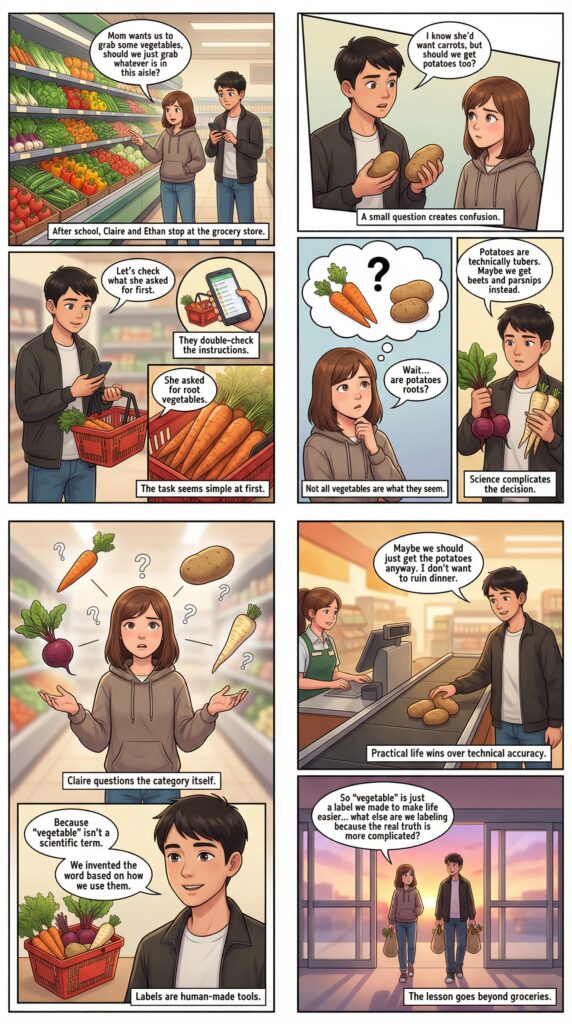
The prototype was reviewed by two peers who provided well-rounded and constructive feedback on the prototype’s strengths and weaknesses. * Each acknowledged that the comic’s setting and characters were very well aligned with the intended objective and helped get the message across in a way the target audience would be able to relate to. The dialogue that took place in the comic felt very natural to the reviewers, which they claimed enhanced the relatability, which was done intentionally through the use of UDL.
The reviewers thought the primary example of vegetables was an excellent choice to use as a bridge to the learning objective, but they found the transition between concepts needed attention. To optimize the educational impact, it was suggested that a couple more panels should be added that include other examples and expand on the broader sociological takeaway.
All of the peer feedback was appreciated and consulted while making the final rendition of the comic strip.
*Peer reviewed by: Emily (emilyn2003) & Dylan (dylanmarino)
Reflect and Refine
REFLECTION:
The overall process of creating this comic went over quite well. Each step provided in the assignment’s template helped me stay on task throughout the whole process and made the assignment’s expectations very explicit. The narrative itself was quite easy to write since the setting and characters were intentionally chosen to be relatable, making it easy to put myself in the characters’ shoes. While writing the script, I kept in mind Glonek and King’s (2014) article on storytelling in the classroom, where they highlighted that learners remember more information when presented in a narrative style. They also wrote about how memories are often episodic, so emphasizing the episodic nature of a story will help learners to remember the order of a lesson. Since the topic I used has a deeper meaning within, I knew these concepts needed to be followed. These intentions and applications were noticed by each peer reviewer of my prototype, which affirmed their place as a crucial stepping stone in my final comic.
FUTURE IMPROVEMENTS:
If I were to do this assignment again, I would draw the comic by hand. In the prototype phase, I attempted to draw the comic, but it had been a while since the last time I drew, and I couldn’t match the expectations I set for myself. Which is when I decided to use a generative AI to create the comic; this decision was guided by hearing about how easy to use and convenient AI is. In reality, much more time was spent using generative AI than if I decided to draw the comic by hand, because I am very unfamiliar with AI applications. The shift from the “Understand” and “Ideation” phases to creating the comic using AI was very stark; I did not feel as connected to the content, because I shifted from actively creating to passively moderating the product.
Looking back at my final comic, I feel very fixated on what did not go right. I had a lot of grief with the text and text bubbles, which eventually led to me exporting the comic with the best visuals to Canva and then reworking the text myself. Although, the chosen comic is one from before I started putting multiple text bubbles in some panels to break up the text. The text bubbles that were instilled in the comic were already quite large and did not leave much space for any others to be added, so instead I reworked the text and included line separations where a separate text bubble would have been most appropriate. I wish I could have added thought bubbles to the final comic, as there was a lot of text that could have been demonstrated with inner thoughts, though since the characters are siblings, I figured all of the script would work well if said out loud. Kogan et al. (2023) explain that showing inner thoughts using thought bubbles helps students develop social and emotional skills and can reduce negative behaviours by helping students to develop empathy for the characters or situation they may be unfamiliar with.
REVISIONS:
After receiving peer feedback, I went back to my storyboard and added four more panels to include a transition between the vegetable example and the takeaway message. Along with this, there were also minor adjustments to the initial plan to ensure consistency throughout. I have become much more confident about what was created after the peer review process because it gave the individually created project a sense of collaboration. Scutter and Wood (2009) argue that including peer reviewing in multimedia learning, especially when complex concepts are being either used or explained, is more effective than the usual top-down feedback from teachers or professors.
STRENGTHS AND LIMITATIONS:
As far as strengths go, making a comic is an excellent way to apply the multimedia principles we have been covering. I also really enjoyed how we could pick what ever topic we wished, which made the process much more enjoyable. This process was also educational for myself too since I picked a topic I wanted to know more about using principles I am already familiar with (active processing principle).
The assignment was also quite creative, which is quite uncommon in academia in faculties outside of the arts. Although, with technological assistance, each student completing the assignment can chose how creative they want to be for this assignment. The comic could have been done entirely by hand or by an AI that can take full creative liberty. Having this chose makes the assignment quite accessible to students from all different faculties and backgrounds, where students can determine which format best fits their past experience. As for limitations, both ways of producing an educational comic, there are many paywalls that limit the comics potential. Whether that be art supplies or subscriptions to digital services that can help make the comic. Because of these monetary restrains, the final comic did not turn out the best that it could have because I did not have access to the best resources.
Final Artifact
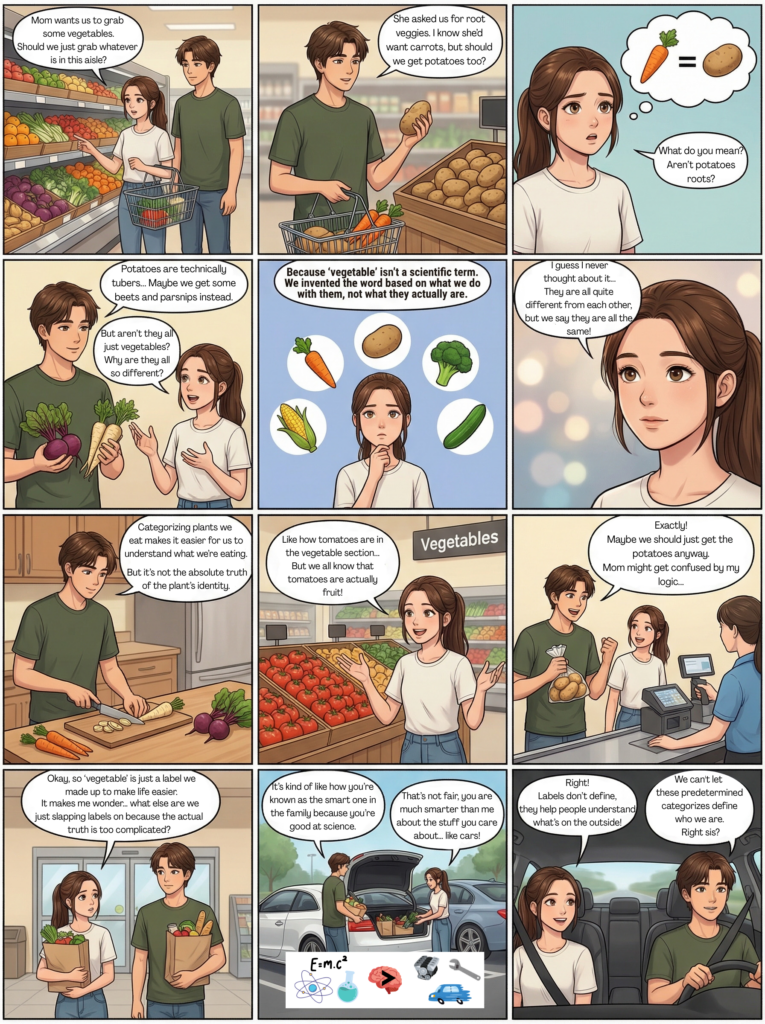
Link to Final Comic in Canva (less blurry)
AI Usage
I acknowledge the use of ChatGPT to generate the comic strip for this assignment. I entered the following prompts on February 25th, 2026: “Can you build a 10-panel educational comic strip with a target audience of high school students? This is for an assignment for an upper-level university education course titled ‘interactive and multimedia learning.'”
Script provided during prototype creation:
Panel #1
- Dialogue- Claire: “Mom wants us to grab some vegetables, should we just grab whatever is in this aisle?”
- Setting- Claire and Ethan in the produce section in a grocery store.
Panel #2
- Dialogue- Ethan: “She asked us for root vegetables. I know she’d want carrots, but should we get potatoes too?”
- Setting- Ethan holding potatoes, with carrots in their basket already
Panel #3
- Dialogue- Claire: “What do you mean? Are potatoes roots?”
- Setting- Claire looking confused, thinking about carrots and potatoes being equal
Panel #4
- Dialogue- Ethan: “Potatoes are technically tubers. Maybe we get some beets and parsnips instead.”
- Setting- Ethan holding beets and parships, looking relfective
Panel #5
- Dialogue- Claire: “But aren’t they all just vegetables? Why are they all so different?”
- Setting- Claire wondering about different kinds of vegetables
Panel #6
- Dialogue- Ethan: “Because ‘vegetable’ isn’t a scientific term. We invented the word based on what we do with them, not what they actually are.”
- Setting- Ethan with just the basket in his hands with the carrots, beets, and parsnips in the basket
Panel #7
- Dialogue- Claire: “I guess I never thought about it. They are all quite different from each other, but we say they are all the same.”
- Setting- Claire thinking about vegetable classification and how we put them all in the same category
Panel #8
- Dialogue- Ethan: “Categorizing the plants we eat makes it easier for us to understand what we are eating, but it’s not really the ‘absolute truth’ of the plant’s identity.”
- Setting- Ethan in a kitchen preparing vegetables
Panel #9
- Dialogue- Ethan: “Maybe we should just get the potatoes anyways. I don’t want to explain to Mom that I didn’t get potatoes because they aren’t really roots, it might ruin dinner.”
- Setting- Ethan holding the potatoes anyways, at the cashier waiting to pay
Panel #10
- Dialogue- Claire: “Okay, so ‘vegetable’ is just a label we made up to make life easier. It makes me wonder… what else are we just slapping labels on because the actual truth is too complicated?”
- Setting- Claire and Ethan outside of a supermarket leaving the store
On March 4th, 2026, to make the final comic, the same resource was used again. gave it the whole script with the dialogues and settings that can be viewed under “Storyboard”.
Script provided during final artifact creation:
Generate an educational comic based off this script-
Target Audience: High school students
Language: English (print)
Characters: Two siblings , Claire and Ethan who look similar.
Layout: Single page 3×4 grid
Script
Panel #1: Row 1, Col 1
Setting: Claire and Ethan in the produce isle of a grocery store, beside a cart.
Dialogue- Claire: “Mom wants us to grab some vegetables; should we just grab whatever is in this aisle?”
Panel #2: Row 1, Col 2
Setting: Ethan holds potatoes; carrots visible in basket.
Dialogue: Ethan: “She asked us for root vegetables.” Ethan: “I know she’d want carrots, but should we get potatoes too?”
Panel #3: Row 1, Col 3
Setting: Claire looking confused, thinking of carrots and potatoes as equal.
Dialogue: Claire: “What do you mean? Aren’t potatoes roots?”
Panel #4: Row 2, Col 1
Setting: Ethan holding beets and parsnips.
Dialogue: Ethan: “Potatoes are technically tubers. Maybe we get some beets and parsnips instead.”Claire: “But aren’t they all just vegetables? Why are they all so different?”
Panel #5: Row 2, Col 2
Setting: Around Claire’s head, a carrot, potato, broccoli, corn, and cucumber. The background is one colour to reduce extraneous load.
Dialogue: Ethan: “Because ‘vegetable’ isn’t a scientific term. We invented the word based on what we do with them, not what they actually are.”
Panel #6: Row 2, Col 3
Setting: Close-up on Claire thinking, calmer expression.
Dialogue: Claire: “I guess I never thought about it. They are all quite different from each other, but we say they are all the same.”
Panel #7: Row 3, Col 1
Setting: Ethan reflecting on a time he was prepping vegetables on cutting board.
Dialogue: Ethan: “Categorizing the plants we eat makes it easier for us to understand what we are eating, but it’s not really the ‘absolute truth’ of the plant’s identity.”
Panel #8: Row 3, Col 2
Setting: Claire in front of tomatoes, with a sign saying “vegetables” behind them.
Dialogue: Claire: “Like how tomatoes are in the vegetable section because of how we use them, but we all know that tomatoes are actually fruit!”
Panel #9: Row 3, Col 3
Setting: Claire and Ethan on the customer side of the counter with groceries
Dialogue: Ethan: “Exactly!” “Maybe we should just get the potatoes anyways. I don’t want to explain to Mom that I didn’t get potatoes because they aren’t really roots, it might ruin dinner.”
Panel #10: Row 4, Col 1
Setting: Claire and Ethan leaving the grocery store, with grocery bags in their arms
Dialogue: Claire: “Okay, so ‘vegetable’ is just a label we made up to make life easier. It makes me wonder… what else are we just slapping labels on because the actual truth is too complicated?”
Panel #11: Row 4, Col 2
Setting: Claire an Ethan loading the groceries into trunk.
Dialogue: Ethan: “It’s kinda like how you’re known as the smart one in the family because you’re good at science.” Claire: “That’s not fair, you are much smarter than me about the stuff you care about… like cars!”
Panel #12: Row 4, Col 3
Setting: Inside the car. Ethan driving and Claire in passenger seat.
Dialogue: Ethan: “We can’t let these predetermined categorizes define who we are, right sis?” Claire: “Right! Labels don’t define, they just help people understand what’s on the outside!”
I acknowledge that there are biases present when using generative AI. For the comic strip, the only characteristics I provided for the characters were their names and that they were siblings. Because of the AI’s popularity bias, it assumed the gender, ethnicity, and culture of each character involved, which obviously leaves out underrepresented and/or marginalized communities.
References
B.C. Curriculum. (2026). Science. https://curriculum.gov.bc.ca/curriculum/science
Glonek, K. L. & King, P. E. (2014). Listening to Narratives: An Experimental Examination of Storytelling in the Classroom, International Journal of Listening, 28:1, 32-46, DOI: 10.1080/10904018.2014.861302
Gunderson, R. (2020). The Mundane Dialectic of Enlightenment: Typification as Everyday Identity Thinking. Human Studies, 43(4), 521–543. https://doi.org/10.1007/s10746-020-09562-3
Kogan, M. S., et al. (2023). Comics-Based Online Course as a Learning Resource for Encouraging Students’ Speaking Activity Through Intensive Independent Learning. In R. A. Sottilare, A. Ioannou, P. Zaphiris, K. Siau, J. Wei, G. Salvendy, F. Fui-Hoon Nah, & J. Schwarz (Eds.), HCI International 2023 – Late Breaking Papers (Vol. 14060, pp. 139–153). Springer. https://doi.org/10.1007/978-3-031-48060-7_11
Linder, R., & Falk-Ross, F. (2024). Multimodal Resources and Approaches for Teaching Young Adolescents: A Review of the Literature. Education Sciences, 14(9), 1010. https://doi.org/10.3390/educsci14091010
Scutter, S., & Wood, D. (2009). Scholarly peer review aimed at enhancing the first-year student learning experience. E-Journal of Business Education & Scholarship of Teaching, 3(2), 1–9.
Sullivan, E. (2023). Postpublication, Measuring Impact, and Multimedia. Refract: An Open Access Visual Studies Journal, 5(2).